
RAG Architecture Guide for LLM Applications
A practical RAG architecture guide for LLM applications covering document ingestion, embeddings, vector databases, retrieval, prompts, APIs, monitoring, security, and cost controls.
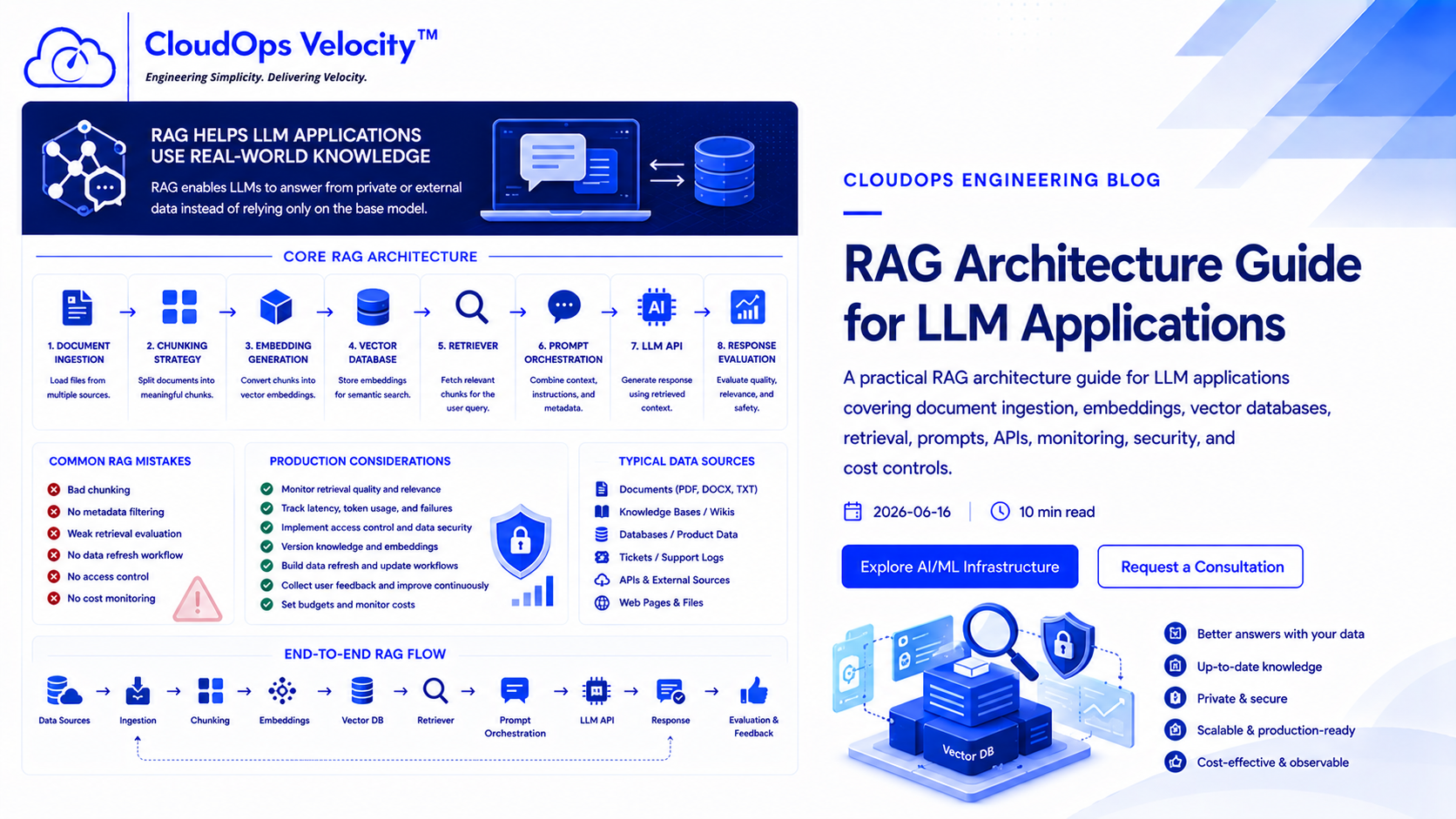
What RAG solves
RAG helps LLM applications use private or external knowledge instead of relying only on the base model.
This is useful when applications need to answer from company documents, knowledge bases, product data, policies, tickets, or frequently updated content.
Core RAG components
A production RAG system requires more than a prompt.
- ✓Document ingestion
- ✓Chunking strategy
- ✓Embedding generation
- ✓Vector database
- ✓Retriever
- ✓Prompt orchestration
- ✓LLM API
- ✓Response evaluation
Common RAG mistakes
Many RAG systems fail because retrieval quality is poor or the knowledge pipeline is not maintained.
- ✓Bad chunking
- ✓No metadata filtering
- ✓Weak retrieval evaluation
- ✓No data refresh workflow
- ✓No access control
- ✓No cost monitoring
Production considerations
Production RAG needs monitoring, security, versioning, cost controls, and user feedback loops.
The architecture must be operational, not just experimental. Teams need visibility into retrieval quality, latency, token usage, failed responses, and access permissions.
Ready to put this into practice?
If your engineering team needs help implementing these practices, we're here to help you architect, automate, and scale your infrastructure.
Frequently Asked Questions
What is RAG architecture?
RAG architecture combines retrieval systems with LLMs so applications can answer using private, external, or frequently updated knowledge sources.
Does RAG need a vector database?
Most RAG applications use a vector database or vector search layer for semantic retrieval, although simpler retrieval systems can work for smaller use cases.