
How to Reduce AWS Costs Without Breaking Production
Learn practical ways to reduce AWS costs using right-sizing, storage cleanup, Savings Plans, S3 lifecycle policies, NAT review, and FinOps governance.
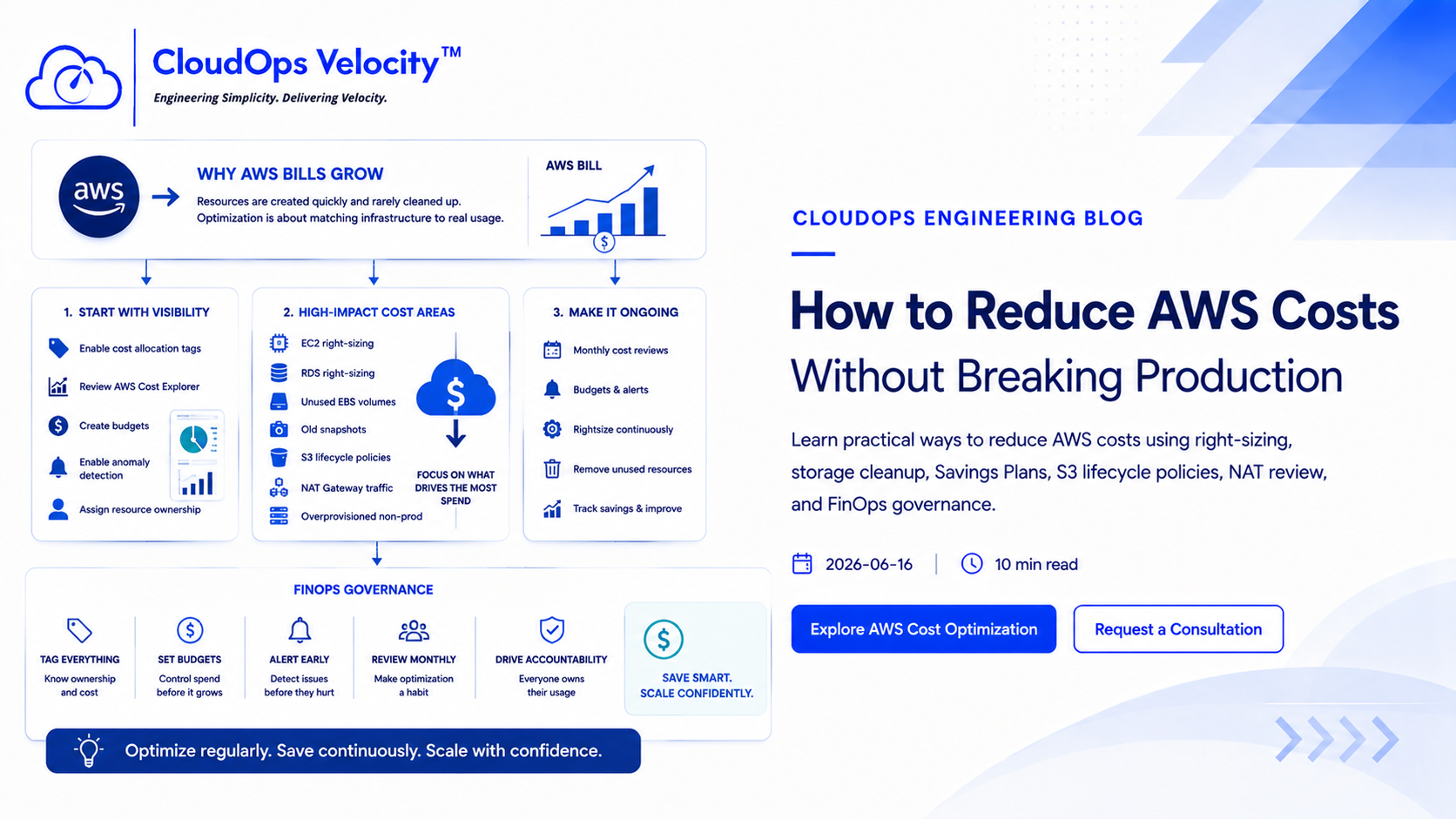
Why AWS bills grow
AWS costs usually grow because teams create resources quickly and rarely come back to clean them up.
Cost optimization is not about blindly deleting resources. It is about matching infrastructure to real usage.
Start with visibility
You cannot optimize what you cannot see.
- ✓Enable cost allocation tags
- ✓Review AWS Cost Explorer
- ✓Create budgets
- ✓Enable anomaly detection
- ✓Assign resource ownership
High-impact cost areas
Most AWS savings come from a few common areas.
- ✓EC2 right-sizing
- ✓RDS right-sizing
- ✓Unused EBS volumes
- ✓Old snapshots
- ✓S3 lifecycle policies
- ✓NAT Gateway traffic
- ✓Overprovisioned non-production environments
Make cost optimization ongoing
One cleanup is not enough. FinOps requires monthly reviews, alerts, budgets, and accountability.
Ready to put this into practice?
If your engineering team needs help implementing these practices, we're here to help you architect, automate, and scale your infrastructure.
Frequently Asked Questions
What is the fastest way to reduce AWS costs?
Start with idle resources, oversized instances, unused storage, old snapshots, and NAT/data transfer costs.
Can AWS costs be reduced safely?
Yes, if optimization is done gradually with monitoring, backups, and rollback planning.